

Managing data, files and documents — and retrieving them quickly and securely — is among the biggest challenges facing organisations: companies, institutions and government departments. Every organisation holds data that strengthens its work, value and commitment to its goals, whether business data or data about employees, clients and products.
Data management
We help clients handle and manage their organisation's data by developing and implementing plans and policies that reinforce its value as one of the organisation's most valuable assets. We work with you to:
- Build and develop data policy, standards and governance.
- Develop data storage, management and control systems.
- Support and qualify the data management team.
- Establish a data management office for the organisation.
Records centre solutions
Organisations need a central records centre that guarantees the safety and full security of their documents. We work with you to establish the records centre inside your organisation through:
Centre fit-out
Supply of fixed, mobile and electric filing cabinets, and space preparation to safety requirements.
Management system
Supply of a records centre management system for registration, loan control, retention periods and disposal.
Electronic archiving
Supply of the electronic archiving and file-sharing system, with scanning of the paper backlog.
Equipment
Production scanners, barcode printers, and filing and tagging supplies.
Operations team
Provision of a records centre operations team, or training of your own staff.
Policy development
Policies and procedures based on the National Center for Archives and Records standards.
Secure disposal
Documented disposal procedures for records whose retention period has expired, per regulations.
Why records management?
Classification & indexing
A unified classification plan that puts every document in its right place, retrievable in seconds.
Easy access
Permission-controlled access for whoever needs the document when they need it, with an audit log of every action.
Regulatory compliance
Adherence to the National Center's regulations, the Personal Data Protection Law and cybersecurity controls.
Inventory & appraisal
Periodic records inventory and retention appraisal to reduce paper volume and cost.
Work stages
- Study and analysis: inventory of current documents, their sources and volume, and understanding of existing procedures and applicable regulations.
- Planning and design: preparation of the classification plan and retention schedules, and design of the centre, system and integrations.
- Execution and sorting: sorting, tagging and entering documents according to the plan, with sample-based quality control.
- Handover and training: delivery of manuals and registers, training of your team, and operational support.
A classification model proposes the classification code and retention period for each document automatically, for one-click review by staff — cutting indexing time and standardising application across departments.
Related system
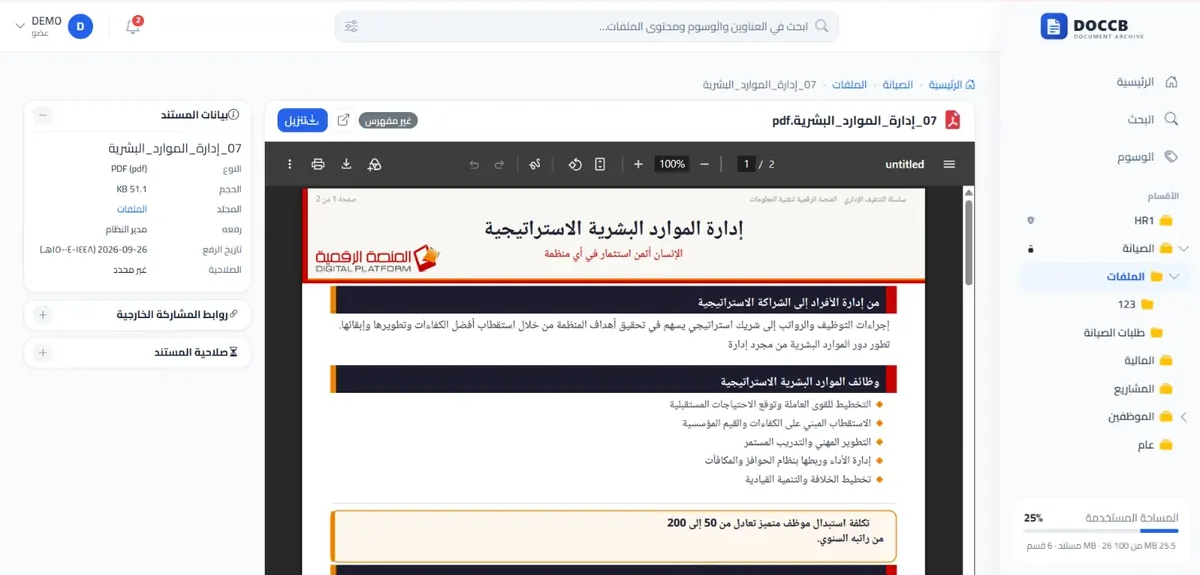
DOCCB Archive
Our own archiving and file-sharing system with a full Arabic interface: sections, permissions and tags, full-text search, and document expiry tracking.
Product detailsFAQ
What is the difference between records management and electronic archiving?
Records management governs the full document lifecycle (creation, classification, retention, disposal) whether paper or digital, while electronic archiving converts paper documents into indexed digital images. The first is methodology and policy; the second is a technical implementation built on top of it.
Does the classification plan follow the National Center for Archives and Records standards?
Yes. We build the classification plan, retention schedules and disposal procedures on the National Center's regulations, and hand over approved, auditable procedure manuals.
How long does setting up a records centre take?
It depends on the document volume and number of departments; mid-sized projects usually take 8 to 16 weeks from study to handover and training. We confirm the duration after the assessment visit.